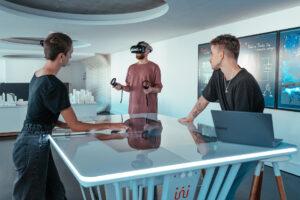
Experienced users don’t even notice it anymore. They put on an XR headset and launch an application without thinking twice. However, for many people, XR is not yet part of their daily lives. So when it comes to putting on a headset, some users may feel apprehensive or even reluctant. And if the goal is to have them experience a product sales presentation or training session, for example, it’s a safe bet that the desired objective will not be achieved.
Because technology too often takes precedence, we felt it was important to share our vision and the importance of emotions in our developments and solutions.
A well-designed and adapted environment

We too often forget that the experience doesn’t just begin when you put on a headset. When we talk about experience design or user experience in virtual reality, many people focus on the content of the immersive application and ignore everything else, as if reality no longer existed once immersed. However, regardless of current and future technological advances, no experience allows or will allow us to completely escape reality.
It is therefore necessary to extend the scope of the experience to the real world. Just as there is no break in Milgram’s continuum, we must favor a smooth transition from the real to the virtual in order to improve the sense of presence in the virtual world.
The experience begins when the door opens. The user enters the room. It could be a showroom, a classroom, or a collaborative space. Whatever it is, as soon as they cross the threshold, the space must be clearly legible. Users must immediately understand and quickly perceive the purpose of their presence in that space. The layout and design are therefore key aspects. They will set the tone. Signage will also help guide participants in discovering and using the space.
The space will generally consist of a reception area, work islands, offices, platforms, or more cozy workspaces, chosen to suit the function. The atmosphere can be studious, creative, sober, and always adapted to the target audience and needs. All this may seem obvious, but it will help create a welcoming and warm atmosphere.
However, it is possible to go further and push the boundaries to work more deeply on the emotional register.
Picture : Virtuality Continuum, Milgram and al.
Causing a change in emotional state
Whether it’s a work meeting, training session, or sales presentation, the emotional state of participants requires special attention to put them in the best frame of mind. A successful welcome will help reduce stress levels and mental load, for example.
Once this stage is over, the goal will be to draw participants into the immersive experience. The transition must be smooth. It is possible to play on different sensory modalities. A particular sound atmosphere or a change in the intensity and tones of the lighting can bring the real space closer to the virtual experience and provide a certain comfort before immersion. The challenge of this real->virtual transition will be to facilitate immersion and the feeling of presence in the immersive experience.
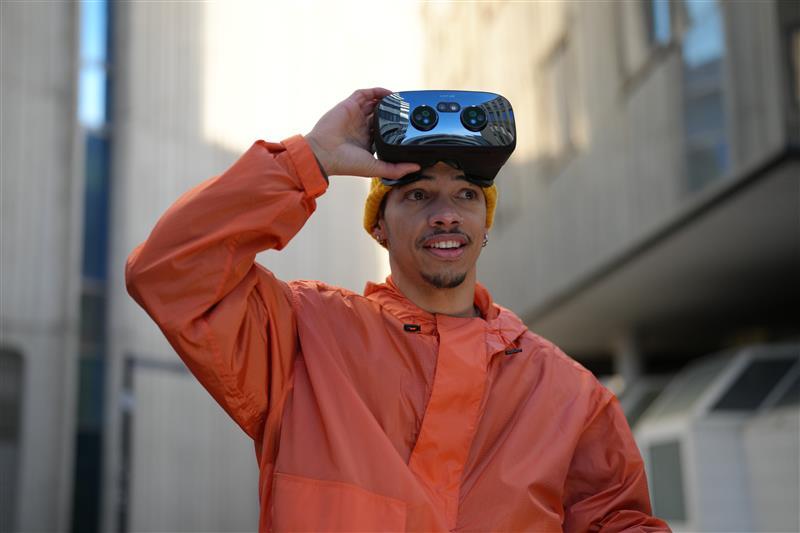
Immersive experiences rich in emotion
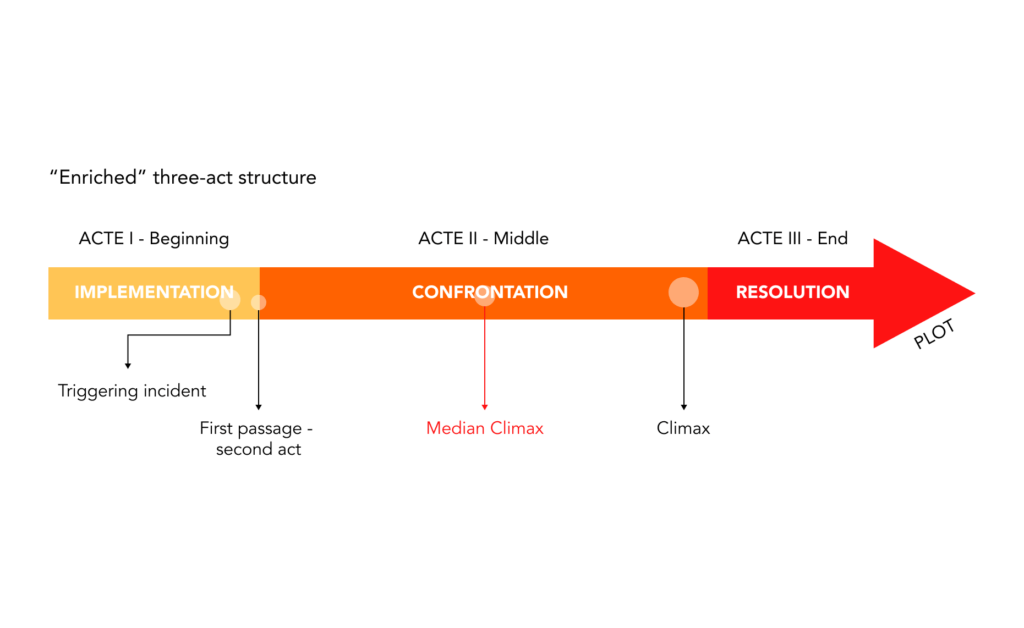
Even in the context of a serious work session, it is interesting to consider an immersive experience as a novel or film scenario.
In a classic three-act structure, the story usually takes a turn at the end of Act 1 after the introduction or setup. This is called the dramatic knot. The story then really takes off and can be disrupted several times as it develops, until it reaches the climax, the point of maximum dramatic intensity. In an educational context, these “disruptions” can take the form of exercises integrated into a quest. We can therefore understand the importance of the real-to-virtual transition in conditioning participants and ensuring that they quickly get into the action.
Return to Earth
The experience is coming to an end and it’s time to return to reality. This return to reality must also be carefully managed in order to retain the benefits of the immersive experience. After the climax, emotions will inevitably subside, but the goal is to keep them at a high level in order to anchor the experience in the participants’ memories. In a showroom, for example, we can imagine that the space has been transformed during the experience so that, once the headset is removed, participants can rediscover elements they encountered during the immersion or images projected on the walls related to the experience. This extension of immersion in reality allows for a smooth “landing,” while maintaining a high level of emotion.
We call this emotional gain, the difference between the initial and final emotional states (see diagram below), ROE for Return On Emotion. And while it is not easily measurable, this concept truly complements the financial gain (ROI) expected when investing in immersive technologies.
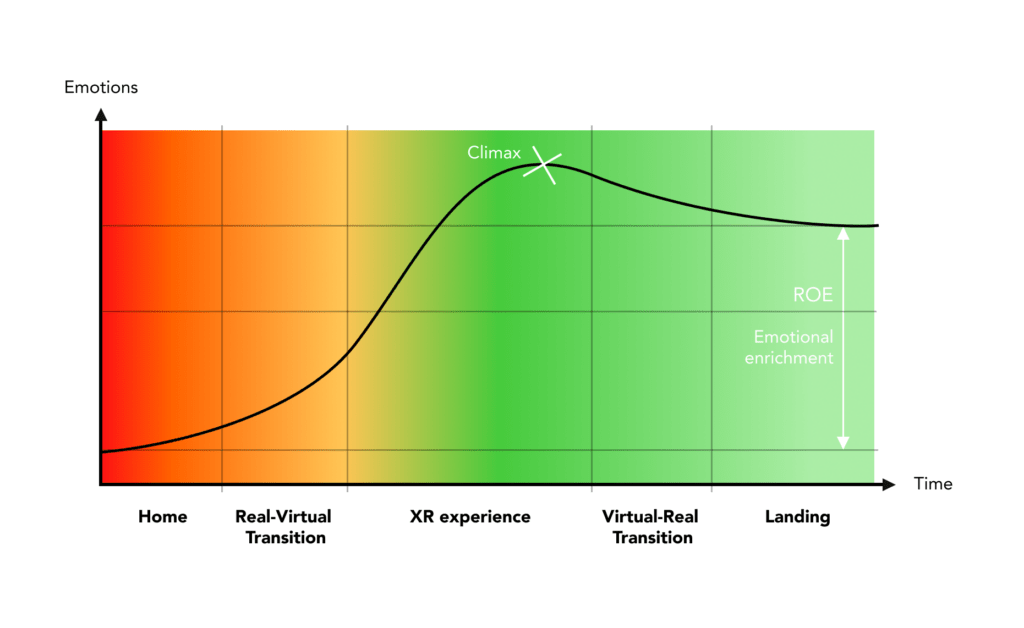
When taking a human-centered approach to design, emotions are an undeniable parameter to be taken into consideration. Obviously, this does not mean creating a Hollywood scenario or a Shakespearean tragedy for all types of immersive experiences. However, the overall mechanics and careful attention to the environment will help you achieve your goals, whether it’s selling a product, designing as a team, or sharing knowledge.
The real and the virtual remain, in any case, intimately intertwined, and no aspect should be overlooked in order to offer a rich and high-quality immersive experience.
Ready to take your projects to the next level?
Our unique approach, fueled by more than 30 years of expertise in XR, allows us to design tailor-made experiences, where every detail is thought out to maximize engagement and emotional return on investment (ROE). By combining technological innovation and storytelling, we support you in creating immersive environments that captivate, inspire, and transform.
Discover our methodology and let’s discuss your needs together to design truly impactful experiences: Learn more about our approach.
Contact us today to talk to our experts and work together to imagine your immersive solutions of tomorrow.